Red dot, holographic or LPVO? It's the question every rifle build comes down to. Each optic type has real strengths and trade-offs, and the right choice depends on how and where you shoot. Here's a clear, no-nonsense comparison to help you decide — with UK-stocked options for each.
Red dot sights
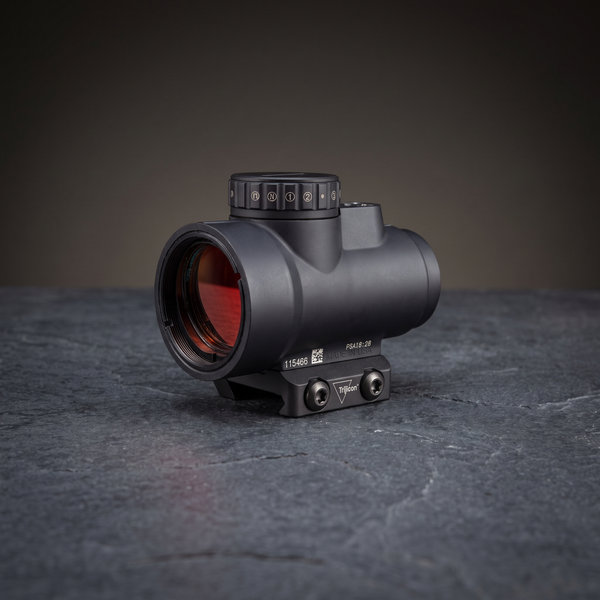
A red dot sight projects a single illuminated dot at 1x magnification. It's fast, lightweight, affordable and simple — both eyes open, put the dot on target, shoot.
Pros: fastest target acquisition up close, light, long battery life, lowest cost.
Cons: no magnification, so distant target ID and precision suffer.
Best for: close-range work, practical disciplines and lightweight builds.
Holographic sights
A holographic sight (think EOTech) projects a laser-illuminated reticle — typically a ring-and-dot — onto the window. The larger reticle and field of view make it extremely fast, and the reticle stays usable even if the window is partially obscured.
Pros: very fast, large field of view, precise ring-and-dot reticle, no parallax.
Cons: shorter battery life than a red dot, higher cost, still 1x without a magnifier.
Best for: fast close-range shooting and those who prefer a feature-rich reticle.
The magnifier option
Both red dots and holographic sights can pair with a flip-to-side 3x or 5x magnifier — giving you 1x speed up close and magnified reach when you flip it in. It's the most flexible way to extend a 1x optic without committing to a full variable scope.
LPVO (low power variable optic)
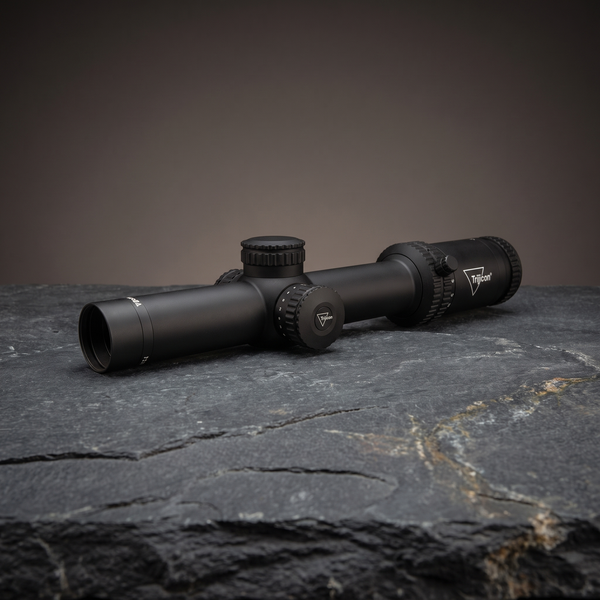
An LPVO is a true variable scope — 1x at the bottom for red-dot-like speed, dialling up to 6x, 8x or 10x for magnified precision. One optic genuinely does it all.
Pros: magnification on demand, excellent for ID and distance, true 1x for close work.
Cons: heavier, pricier, and not quite as instantly fast as a dot at 1x.
Best for: general-purpose rifles, competition and mixed-distance shooting.
Don't forget prism scopes
A fourth option: the prism scope. Fixed magnification with an etched reticle that works without batteries and suits shooters with astigmatism (who may see a red dot as a smear). A great middle ground if a dot looks blurry to you.
Which should you choose?
- Pure speed, close range: red dot or holographic.
- One optic for everything: LPVO (1-6x or 1-8x).
- Speed now, reach later: red dot or holographic + magnifier.
- Astigmatism: prism scope.
See every option for your build in the AR-15 Optics collection, and for a deeper dive into specific models read our guide to the best AR-15 optics in 2026. Building a straight-pull on a Section 1 certificate? Our best optics for a straight-pull AR guide applies this comparison to that rifle specifically.
Frequently asked questions
Is a holographic sight better than a red dot?
Not strictly — holographics offer a richer reticle and faster acquisition for some, but red dots are lighter, cheaper and have far longer battery life. Both are excellent at 1x.
Is an LPVO worth it over a red dot?
If you shoot beyond around 100m or need to identify targets at distance, yes. For pure close-range use, a red dot is lighter and faster.
Can I use a magnifier with an LPVO?
No — an LPVO already has built-in magnification. Magnifiers are for pairing with 1x red dots and holographic sights.