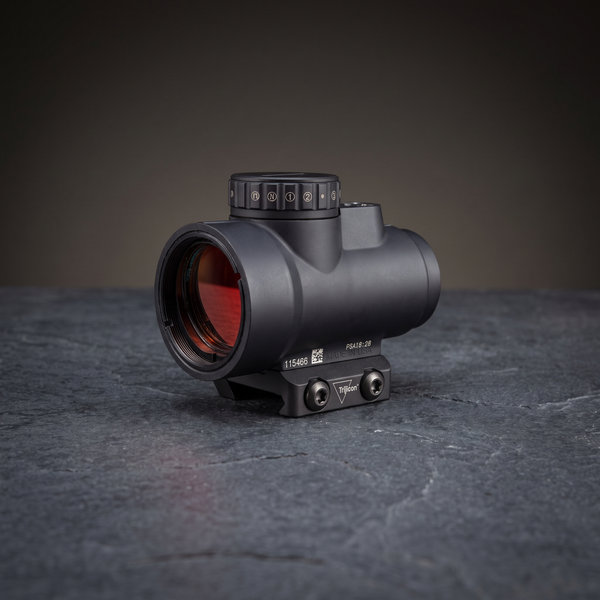
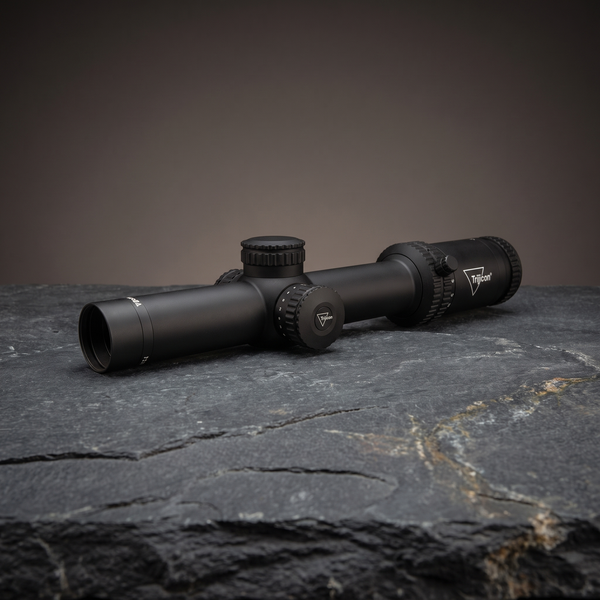
Between the simple red dot and the variable rifle scope sits an often-overlooked option: the prism scope. For many shooters — especially those with astigmatism — it is the most useful sight of the three. Here is what a prism is, how it differs from a red dot, and when it is the right call.
How a prism scope works
Instead of the simple lens system of a reflex red dot, a prism scope uses a glass prism to focus the image, much like a compact rifle scope. That prism lets the optic etch the reticle directly into the glass. The result is a defined, glass-etched aiming point that works whether or not the illumination is switched on — a real advantage if your battery dies. You can see the format across our prism scope range.
The astigmatism advantage
This is the headline benefit. Shooters with astigmatism often see a red dot as a smear, comet or starburst rather than a crisp point, because the dot's light passes through the eye's imperfect lens. A prism scope's reticle is etched and focused through the optic itself, and the eyepiece has a diopter you adjust to your eye. For many people with astigmatism, a prism is the first optic that finally gives them a clean, sharp reticle. Our guide to blurry red dots explains what is happening and what else can help.
Prism vs red dot
| Prism scope | Red dot | |
|---|---|---|
| Reticle | Etched, works without battery | Illuminated dot only |
| Astigmatism | Excellent — crisp reticle | Can appear blurred |
| Magnification | Fixed 1x, 3x, 5x common | True 1x |
| Eye relief | Fixed — needs consistent head position | Unlimited, very forgiving |
| Reticle detail | BDC / ranging possible | Simple dot or circle-dot |
Magnification and reticle options
Prisms come in fixed magnifications — 1x for close-quarters speed, and 3x or 5x for reach. Because the reticle is etched, makers can pack in useful detail: bullet-drop compensation, ranging brackets and horseshoe surrounds. Primary Arms' ACSS reticle system is a standout here, combining a fast central aiming point with holdovers and ranging cues in one intuitive picture — see the Primary Arms prism range. On a 1x MicroPrism you get red-dot speed with an etched reticle; step up to a 3x or 5x prism and you gain target identification and hold precision at distance. On a straight-pull rifle, where a fixed magnification is often all you need, prisms sit alongside the rest of our straight-pull rifle optics.
The trade-offs
Prisms are not perfect for everyone. They have a fixed eye relief and a defined eye box, so you must be more consistent with head position than with a forgiving reflex sight. Magnified prisms are also a touch heavier than a bare red dot. For pure speed at arm's length with unlimited eye relief, a red dot still wins — and if you want both speed and reach from one optic, an LPVO is the other way to solve it, as this comparison sets out.
Who should buy a prism scope?
- Anyone with astigmatism who has struggled to get a clean red dot.
- Carbine shooters who want an etched reticle with BDC for occasional reach, in a compact package.
- Shooters wanting one do-it-all optic — a 1x prism for CQB or a 3x for a blend of speed and distance.
If a red dot has never looked quite right to you, a prism scope may be a revelation. Browse our Primary Arms MicroPrism and wider prism scope range, pick a mount to suit your rifle, and get in touch if you would like help choosing a magnification and reticle.