If you've shopped for a pistol red dot sight, you've hit two terms that decide whether an optic will actually bolt onto your slide: RMR footprint and RMSc footprint. Get it right and the optic drops straight on and holds zero. Get it wrong and the screw holes simply won't line up. This guide explains the difference in plain English so you can buy with confidence.
What is an optic “footprint”?
A footprint is the pattern of screw holes, recoil lugs and the overall mounting shape on the bottom of a red dot sight — and the matching cut milled into your slide (or the adapter plate it ships with). Because there's no single universal standard, optic makers design to a handful of common patterns. The two that dominate are the Trijicon RMR and the Shield RMSc.
The RMR footprint
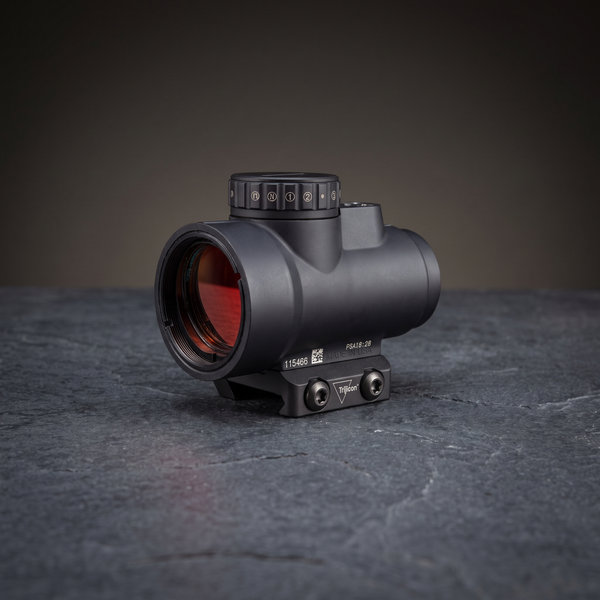
The RMR footprint was set by the Trijicon RMR and has become the most widely supported standard for full-size pistols. It's a robust pattern with two screws and recoil lugs that shrug off hard use.
RMR-footprint optics in our range include the Holosun 507C and 407C series, the competition 507COMP, and the Trijicon RMR and SRO. It's the footprint to choose for Glock MOS, Walther PDP, Springfield Prodigy and most full-size optics-ready pistols (usually via an included adapter plate).
The RMSc footprint
The RMSc footprint (Shield RMSc) is smaller and narrower, designed for slim, single-stack and micro-compact pistols where a full-size RMR cut won't fit. If your slide — or your airsoft replica's slide — is a SIG P365, Glock 43X/48 MOS, Smith & Wesson Shield Plus or Springfield Hellcat pattern, this is almost certainly your footprint.
RMSc optics in our range include the Holosun 507K and 407K micro red dots and the fully sealed EPS Carry family.
RMR vs RMSc: quick comparison
- Size: RMR is larger (full-size); RMSc is compact.
- Best for: RMR — full-size pistols and range use; RMSc — slim slides and micro-compacts.
- Window: RMR optics generally offer a bigger viewing window; RMSc optics are lighter and lower-profile.
- Pistols: RMR — Glock MOS, PDP, Prodigy; RMSc — P365, 43X/48, Hellcat, Shield Plus.
How to find your footprint
Three quick ways: (1) check what your optics-ready pistol's manual or included plates specify; (2) measure the slide cut and compare to the maker's footprint diagram; (3) if you're buying an adapter-plate system, choose the plate that matches your optic. For a model-by-model breakdown across every common pattern, see our pistol red dot footprint compatibility chart — and if you run a Glock, the Glock MOS optic fitting guide matches every common optic to the right plate. Footprint compatibility is exact, so when in doubt, contact us with your exact model and we'll point you to compatible optics.
What about enclosed optics?
Footprint and emitter type are separate choices. Both RMR and RMSc patterns come with open or fully enclosed emitters — the full-size EPS and the RMSc EPS Carry being popular sealed options that resist dirt and moisture.
Ready to choose?
Shop by footprint to guarantee a fit: RMR Footprint Red Dot Sights for full-size pistols, or RMSc Footprint Red Dot Sights for slim slides. Browse the full pistol dot sights range to compare every option, use our footprint compatibility chart to match your exact pistol, or read our guide to compact pistol red dot sights. Building a rifle too? Read our guide to the best AR-15 optics in 2026.
Frequently asked questions
Can I put an RMSc optic on an RMR-cut slide?
Not directly — the patterns differ. Some adapter plates bridge footprints, but always confirm the specific plate supports your optic and slide combination.
Is the RMR footprint the same as the RMR HD?
No. The newer Trijicon RMR HD uses an updated footprint that differs from the classic RMR — check compatibility before buying mounts or plates.
Which is more durable?
Both are proven. The RMR's larger pattern and recoil lugs make it the tougher of the two, while RMSc optics are engineered specifically for the rigours of slide-ride use on a small gun.