MOA crops up everywhere in optics — “2 MOA dot”, “1 MOA clicks”, “sub-MOA accuracy”. It sounds technical, but it's simple once explained. Here's what MOA means and why it matters when choosing and zeroing an optic.
What is MOA?
MOA stands for Minute of Angle — an angular measurement equal to 1/60th of a degree. The handy part: 1 MOA equals roughly 1 inch at 100 yards, which in the units British ranges actually use is 29 mm at 100 m. Because it's an angle, it scales with distance: about 29 mm at 100 m, 58 mm at 200 m, and 15 mm at 50 m.
Manufacturers print the imperial figure because almost every optic sold anywhere is designed in the United States, so both numbers are given throughout this page. The metric one is the one you will use at the firing point.
MOA and dot size
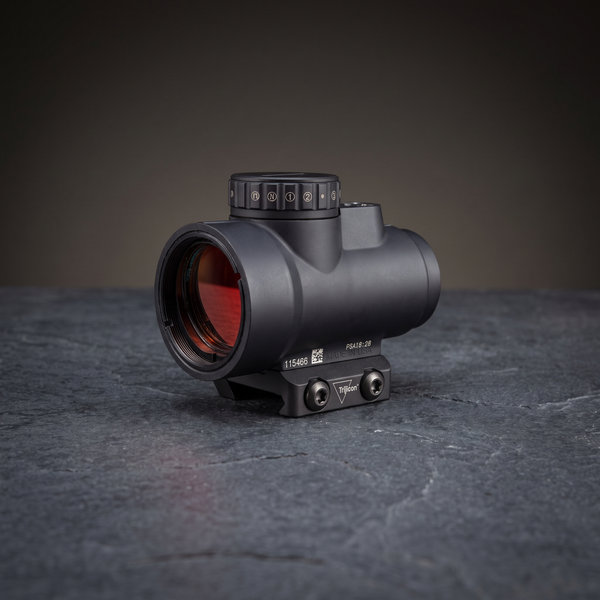
A red dot's size is given in MOA — it describes how much of the target the dot covers. A 2 MOA dot covers about 58 mm at 100 m (2 inches at 100 yards): small and precise. A 6 MOA dot covers about 175 mm at 100 m: bigger and faster to find, but less precise at distance. Speed-first shooters often prefer a larger dot; precision shooters prefer smaller.
MOA and adjustments
Turret and click values are given in MOA too. 1 MOA per click moves your point of impact about 29 mm at 100 m (roughly 1 inch at 100 yards), so about 7 mm at 25 m. Many optics use 1 MOA clicks; some use 1/2 MOA for finer adjustment. Knowing this lets you calculate exactly how many clicks to move your group when zeroing — see our mounting and zeroing guide.
Quick reference
- 1 MOA ≈ 29 mm at 100 m (1.047 in at 100 yd)
- 1 MOA ≈ 7 mm at 25 m (0.26 in at 25 yd)
- 2 MOA dot ≈ 58 mm coverage at 100 m
- 6 MOA dot ≈ 175 mm coverage at 100 m
For dot coverage and click values across every range in one place, see our MOA at distance chart, which gives both unit systems side by side.
MOA vs MRAD
MRAD (milliradian) is the metric-friendly alternative, where 1 MRAD is exactly 100 mm at 100 m (about 3.6 inches at 100 yards), and one 0.1 MRAD click is exactly 10 mm at 100 m. That tidiness is why most metric-country shooters prefer it. Both are just units — pick whichever your reticle and turrets use and stay consistent. Full comparison in MRAD vs MOA explained.
Choosing dot size by use
- 2 MOA: precise, a good all-rounder, better at distance.
- 3–4 MOA: balanced speed and precision.
- 6+ MOA: fastest pickup for close range and fast-moving targets.
Browse red dot sights, pistol dot sights and rifle scopes by reticle and dot size, or read our best pistol red dots guide.
Frequently asked questions
What does MOA mean on a red dot?
It's the size of the dot in angular terms — a 2 MOA dot covers about 58 mm at 100 m, or 2 inches at 100 yards. Smaller is more precise; larger is faster to acquire.
Is a 2 MOA or 6 MOA dot better?
2 MOA is more precise at distance; 6 MOA is faster up close. Choose based on your typical range — 6 MOA suits close, fast shooting.
How much is 1 MOA at 100 metres?
About 29 mm (1.047 inches at 100 yards). It scales with distance — roughly 58 mm at 200 m and 7 mm at 25 m.