Every rifle scope listing says FFP or SFP, and it changes how the scope behaves more than almost any other spec. Here's the difference in plain English.
The one-sentence version
In a first focal plane (FFP) scope the reticle sits in front of the magnifying lenses, so it grows and shrinks with zoom — its measurements stay true at every power. In a second focal plane (SFP) scope the reticle sits behind them, so it always looks the same size — but its measurements are only true at one magnification (usually max).
Side by side
| FFP | SFP | |
|---|---|---|
| Reticle size | Scales with zoom | Constant |
| Holdovers/ranging | True at any power | True at one power only |
| At 1x (LPVO) | Reticle very fine | Bold, red-dot-like |
| At max power | Detailed and usable | Can look coarse on small targets |
| Price | Typically higher | Typically lower |
When FFP wins
- You dial or hold over at mixed magnifications — the MOA/MRAD marks always mean what they say (brush up with what is MOA? and the MOA at distance chart).
- Longer-range work where you range with the reticle.
When SFP wins
- LPVOs used like a red dot. At 1x an SFP reticle stays bold and fast; an FFP reticle at 1x can shrink to a hair. That's why many of the best 1-6x LPVOs are SFP.
- Fixed-magnification habits — if you shoot at max power anyway, SFP costs you nothing and saves money.
- Hunting in low light — the constant, bolder reticle is easier to pick up against cover.
The LPVO question
For a 1-6x used two-eyes-open up close: SFP, usually with an illuminated centre — or a smart ranging design like the ACSS (see what is the ACSS reticle) that builds drop compensation into the reticle so focal plane matters less. For 1-8x/1-10x scopes where you'll genuinely shoot at distance with holdovers, FFP starts earning its premium.
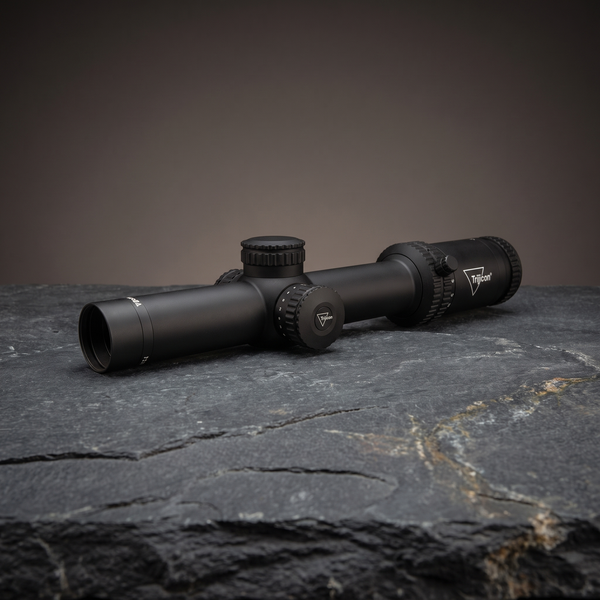
Trijicon offer several ranges in both planes, which makes them a useful way to see the difference within one family — the Trijicon rifle scopes decoded guide sets out which is which.
Compare both types in our LPVO range and full rifle scope collection — every listing states its focal plane in the spec table. Undecided between optic types entirely? Read red dot vs holographic vs LPVO. Duty paid, with £5 tracked UK delivery.