Air rifle shooters are the largest group of shooters in Britain by a comfortable margin, and they get the least written for them. So here is the straight answer: there is no restriction at all on the optic you fit to an air rifle in the UK. There are, however, several real restrictions on the rifle, on who may hold it and on how you store it — and those catch people out constantly.
First, the rules on the rifle
Whether an air weapon is exempt from certification depends on its muzzle energy and, increasingly, on which part of the UK you are in.
| England and Wales | Scotland | Northern Ireland | |
|---|---|---|---|
| Air rifle | Exempt up to 16.3 J (12 ft-lb); above that it is a section 1 firearm needing an FAC | Any air weapon needs an air weapon certificate | Firearm certificate needed above 1 joule |
| Air pistol | Exempt up to 8.1 J (6 ft-lb); above that it is treated as specially dangerous | Any air weapon needs an air weapon certificate | Firearm certificate needed above 1 joule |
| Licensing body | Your local police force | Police Scotland | PSNI Firearms and Explosives Branch |
The England and Wales thresholds come from the Firearms (Dangerous Air Weapons) Rules 1969 and are set out plainly on police air weapons guidance. In Scotland, the Air Weapons and Licensing (Scotland) Act 2015 changed the picture completely: since 31 December 2016 you need an air weapon certificate or permit to buy, acquire or possess any air weapon, regardless of power, as Police Scotland set out. In Northern Ireland, PSNI guidance treats an air gun capable of discharging a missile above one joule as requiring a firearm certificate — a threshold sixteen times lower than the English one.
The rules on the optic: there are none
Nothing changes when you fit glass. As we explain in do you need a licence for a rifle scope, section 57(1) of the Firearms Act 1968 catches lethal barrelled weapons, prohibited weapons, certain component parts and noise or flash accessories — not sights. A scope, a red dot, a prism, a laser or a torch on a sub-12 ft/lb air rifle needs no certificate, no entry and no permission, in all four nations. Nor does fitting one change the rifle's classification: that turns on muzzle energy, not on what is bolted to the rail.
The rules that actually catch air rifle shooters out
- Pellets crossing a boundary. Section 21A of the Firearms Act 1968, inserted by section 34 of the Violent Crime Reduction Act 2006, makes it an offence for a person of any age to fire an air weapon beyond the boundary of the premises where they are shooting. There is a defence where the occupier of the neighbouring land has consented. This is the single most commonly broken air rifle rule in Britain.
- Secure storage. Owners must take reasonable precautions to prevent access by under-18s. BASC's guidance notes this comes from the Crime and Security Act 2010 and that a locked cabinet or cupboard, a locking device or a security cord is expected — a trigger guard lock on its own is not enough.
- Age. Under-18s cannot buy, hire or be given an air weapon or its ammunition. Those aged 14 to 17 may use one unsupervised on private premises with the occupier's consent; under-14s must be supervised by someone aged 21 or over. Scotland's certificate scheme sits on top of all of that.
- Quarry. What you may shoot is a wildlife-law question, not a firearms one. Section 11(2) of the Wildlife and Countryside Act 1981 also prohibits using a lamp, a dazzling device or a night-shooting sighting device against any Schedule 6 animal — badger, hedgehog, otter, pine marten, polecat, red squirrel, dormice, shrews, wildcat and bats. Grey squirrel is not on that list.
- Lead is not going anywhere. The UK REACH lead restrictions confirmed for England, Scotland and Wales explicitly do not affect airgun pellets, for target or live quarry.
Choosing a scope for sub-12 ft/lb
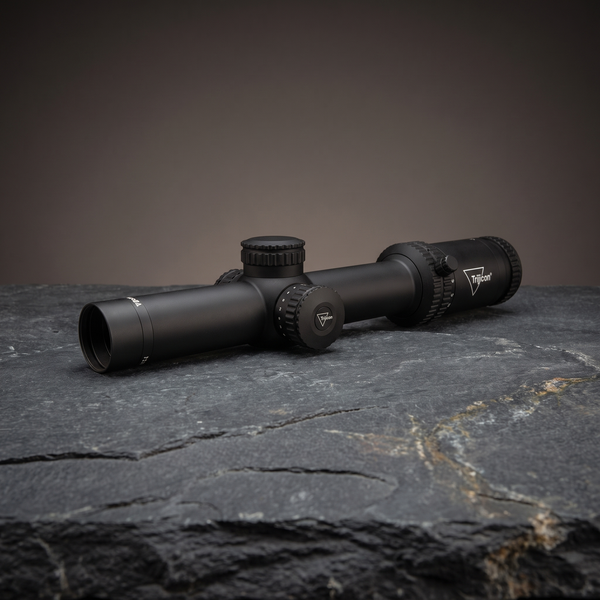
Air rifle ballistics are a different problem from centrefire ballistics, and the optic that suits them is a different optic. Three things matter more than magnification.
1. Parallax that comes down to air rifle distances
This is the big one. A fixed-parallax rifle scope is typically set for around 100 yards, which means a target at 15 m is genuinely out of focus and your point of aim shifts with head position. Air rifle shooting happens between roughly 10 and 45 m. Look for an adjustable objective or side focus that racks down to about 10 m — it sharpens the picture and, for hunting field target and HFT shooters, doubles as a rangefinder.
2. Sensible magnification
High magnification narrows the field of view, shrinks the exit pupil and magnifies your wobble. For general hunting and plinking, something in the 3-9x or 2-7x bracket does everything. The same low-power scopes we group under rimfire and .22LR optics suit air rifles for exactly the same reasons — similar distances, similar target sizes, similar need for a low bottom end.
3. A reticle with holdover marks
A pellet drops a great deal between 20 and 40 m, so a plain duplex crosshair leaves you guessing. A mil-dot or ladder-style reticle gives you repeatable aim points once you have mapped them on paper. Our guides to what MOA means and the MOA at distance chart explain how to convert those subtensions into real distances.
Mounting: the part people get wrong
Most air rifles use an 9.5-11 mm dovetail rather than a Picatinny rail, though Picatinny is increasingly common on PCPs. Check which you have before ordering — rings for one will not fit the other without an adapter. Two further points:
- Spring-piston rifles recoil in two directions. The forward-and-back impulse of a springer is hard on optics and on mounts, and it will walk a scope forward on a smooth dovetail. Use rings with an arrestor or scope stop pin, and check the manufacturer rates the scope for spring-piston use.
- Get the height right. Air rifle scopes with large objectives often need medium or high rings to clear the barrel or moderator. Our mounts and rings buyer's guide covers the choice, and the mount range is here.
Red dots and prisms on air rifles
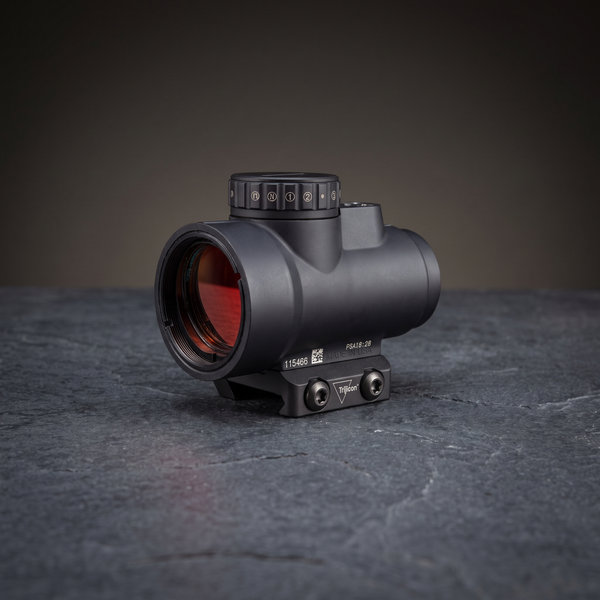
A red dot is a genuinely good choice on a light air rifle used for close-range plinking, pest control in outbuildings, or by a younger shooter who struggles with a scope's eye box. It is fast, forgiving of head position and weighs almost nothing. What it will not do is help you judge a small target at 40 m.
If you find red dots smear or starburst, that is usually astigmatism rather than the sight — our guide to blurry red dots explains it, and a prism scope with its etched reticle is often the fix. See prism scopes explained.
Lamps and night vision
Torches and lamps are ordinary goods with no licensing attached, and a good handheld torch earns its place on a rat night. The limits are on the quarry, not the kit — the Schedule 6 restriction above, and any conditions in the general licences that apply where you shoot. Our article on night vision and thermal law covers the wider position, and lumens vs candela explains why throw matters more than headline output.
This is not legal advice
Air weapon law diverges more than almost any other part of UK firearms law: England and Wales, Scotland and Northern Ireland each take a different approach, and quarry law adds another layer on top. Confirm the current position with your own force's firearms licensing department, Police Scotland or PSNI before you act on anything here.
Frequently asked questions
Do I need a licence for an air rifle scope in the UK?
No. Optics are not firearms or component parts, so no certificate is needed anywhere in the UK, whatever the rifle.
Does fitting a scope make my air rifle a licensable firearm?
No. Classification depends on muzzle energy — 16.3 J (12 ft-lb) for rifles in England and Wales — not on sights.
What magnification should an air rifle scope be?
For most hunting and plinking inside 45 m, 2-7x or 3-9x is plenty. Parallax adjustment down to about 10 m matters far more than top-end power.
Do I need an air weapon certificate in Scotland?
Yes. Since 31 December 2016, any air weapon in Scotland requires an air weapon certificate or permit, regardless of power.
Browse rimfire and .22LR optics, the wider rifle scope range, red dot sights and mounts — all held in our UK warehouse and dispatched from here.