It is the question we are asked more than any other by shooters buying their first optic: does the scope itself need to go on a licence? The short answer is no. The reasons why are worth understanding, though, because they tell you exactly where the line sits between kit you can simply buy and kit that needs paperwork.
The short answer
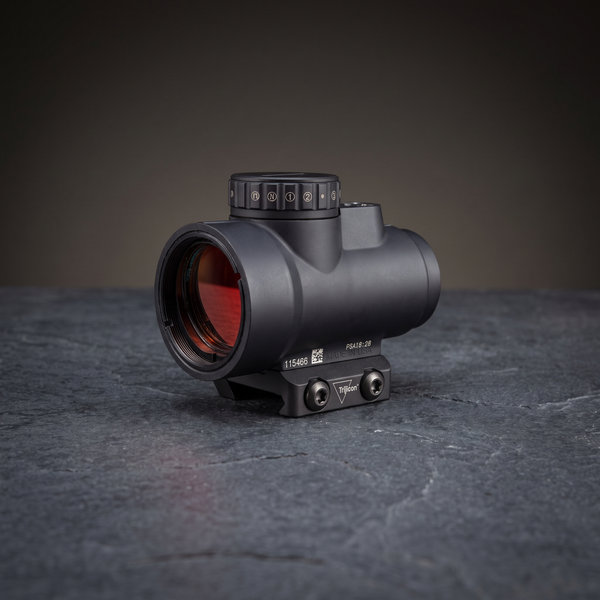
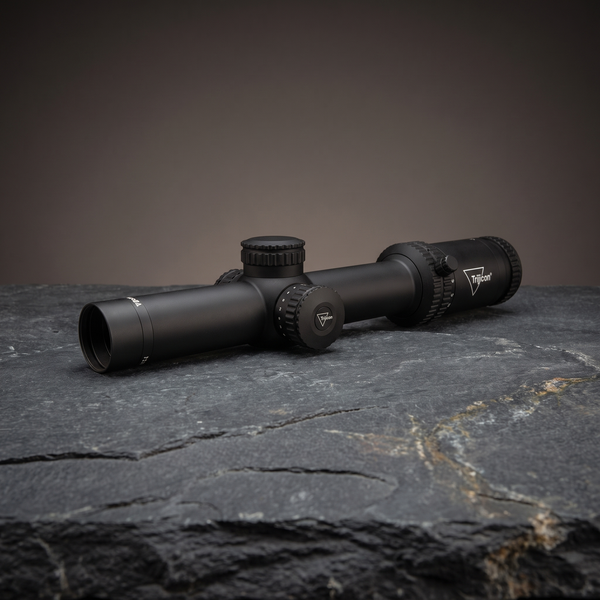
In the United Kingdom, optics are not licensed — firearms are. A rifle scope, red dot sight, holographic sight, magnifier, prism scope, laser or weapon light is not a firearm in law, is not a component part of one, and does not appear on any certificate. You can buy one, own one, lend it and sell it without holding a certificate of any kind. What is certificated is the gun you fit it to.
Why an optic falls outside the definition
Section 57(1) of the Firearms Act 1968 defines a firearm as a lethal barrelled weapon — one that discharges a projectile with kinetic energy of more than one joule at the muzzle — together with prohibited weapons, certain relevant component parts, and one narrow category of accessory.
The relevant component parts are the pressure-bearing and action parts: the barrel, chamber or cylinder; the frame, body or receiver; and the breech block or bolt. The only accessory the definition catches is one "designed or adapted to diminish the noise or flash caused by firing the weapon" — a sound moderator or flash hider.
A telescopic sight is none of those things. Neither is a red dot, a set of scope mounts, a magnifier or a torch. They sit outside the definition altogether, which is why no police force in Great Britain asks you to list them and no dealer asks to see a certificate before selling you one.
What is certificated: FAC and SGC in outline
In England, Wales and Scotland there are two main certificates. The Home Office Guide on Firearms Licensing Law is the reference your force works from.
| Firearm certificate (FAC) | Shotgun certificate (SGC) | |
|---|---|---|
| Covers | Section 1 firearms — rifles and other non-shotgun firearms, plus their ammunition | Section 2 shotguns |
| Good reason | Must be shown for each firearm and calibre — "on a regular, legitimate basis for work, sport or leisure" | No equivalent requirement, though police may refuse where satisfied there is no good reason |
| What is listed | Each firearm individually, with the ammunition you may buy and hold | The shotguns you hold |
| Conditions | Commonly include secure storage and, on stalking rifles, land and quarry conditions | Commonly include secure storage |
Nothing in either certificate is about sights. The certificate describes the gun, the calibre and the ammunition — not the glass on top of it.
The one accessory that used to need paperwork
Sound moderators are the exception that proves the rule, and the position has recently changed. Because a moderator is an accessory designed to diminish noise, it fell squarely inside the section 57 definition and had to be entered on a certificate. Section 44 of the Crime and Policing Act 2026 removed moderators from firearms licensing control in England, Wales and Scotland with effect from 29 June 2026, a change the Home Office guide records at paragraph 1.4. Existing entries fall away when a certificate is next renewed.
If you shoot with a moderator, read the current Home Office guidance and your force's own notes rather than relying on older articles — this one is genuinely new and the detail matters. Optics, by contrast, never needed to be listed at all.
Does fitting an optic change a firearm's legal status?
No. Whether a gun is a section 1 firearm, a section 2 shotgun or an exempt air weapon turns on the gun itself — bore, barrel length, overall length, action type, magazine capacity, muzzle energy. None of those tests refers to the sight. Fitting a 1-6x LPVO to a straight-pull, a red dot to a shotgun or a magnified scope to a stalking rifle reclassifies nothing.
Two caveats are worth stating plainly. First, certificate conditions are personal to you: they are set by your force and can be varied, so if you are unsure whether something is within your conditions, ask your firearms licensing department rather than a forum. Second, owning an optic and using it are different questions — how you use a sight or a lamp is regulated in several places even though buying one is not.
Where the use of a sight or light is regulated
Two examples British shooters run into most often:
- Deer at night. Under section 3 of the Deer Act 1991 it is an offence in England and Wales to take or intentionally kill deer between the expiry of the first hour after sunset and the beginning of the last hour before sunrise, unless an exemption or licence applies. Scotland has its own scheme. Our guide to night vision and thermal law in the UK sets out both.
- Protected species. Section 11(2) of the Wildlife and Countryside Act 1981 makes it an offence to use "any device for illuminating a target or sighting device for night shooting", or "any artificial light, mirror or other dazzling device", to take or kill any wild animal listed in Schedule 6 — badger, hedgehog, otter, pine marten, polecat, red squirrel, dormice, shrews, wildcat and bats among them. A lamp or a thermal sight does not become unlawful to own; it becomes unlawful to point at those animals.
Scotland and Northern Ireland
The FAC and SGC system is the same in Scotland, administered by Police Scotland, and optics are equally unlicensed there. Scotland has one extra layer that Great Britain's other nations do not: since 31 December 2016 an air weapon certificate is required to buy, acquire or possess any air weapon, under the Air Weapons and Licensing (Scotland) Act 2015. That still says nothing about the scope you put on it — see our guide to air rifle optics in the UK.
Northern Ireland runs a separate regime under the Firearms (Northern Ireland) Order 2004, administered by the PSNI Firearms and Explosives Branch. It differs from Great Britain in several respects: there is no separate shotgun certificate, and air guns capable of discharging a missile with kinetic energy above one joule need a firearm certificate. Optics are not licensed in Northern Ireland either, but because the whole framework is different, NI shooters should take their answers from PSNI and not from GB guidance.
What a UK retailer needs from you
For an optic, mount, light or bipod: nothing. No certificate, no dealer transfer, no entry in a register. That is why rifle scopes, red dot sights and weapon lights ship to your door like any other goods. We cover the customs and dealer side in buying optics in the UK.
A word on what this article is not
This is a plain-English explanation of the framework, not legal advice. Firearms law is amended often, conditions vary by certificate and by force, and the position in Northern Ireland differs from Great Britain throughout. Before you rely on anything here, confirm it with your own force's firearms licensing department, your certificate conditions, or a solicitor.
Frequently asked questions
Do I need a firearms licence to buy a rifle scope in the UK?
No. A rifle scope is not a firearm or a component part under section 57(1) of the Firearms Act 1968, so no certificate is needed to buy, own or sell one.
Do I need a licence for a red dot sight or a weapon light?
No. Red dot sights, holographic sights, magnifiers, lasers and torches are all outside the statutory definition of a firearm.
Does putting a scope on my rifle change what my certificate allows?
The classification of the firearm does not change. Your certificate conditions are a separate matter and are set by your force — if in doubt, ask them.
Do sound moderators still have to be on a certificate?
Not since 29 June 2026 in England, Wales and Scotland, following section 44 of the Crime and Policing Act 2026. Check the current Home Office guide for the detail.
Ready to choose? Start with rifle scopes or red dot sights, work out your magnification with what is MOA?, and if you are stalking see our deer stalking scopes and the guide to red dots for deer stalking. Everything is held in our UK warehouse and dispatched from here.