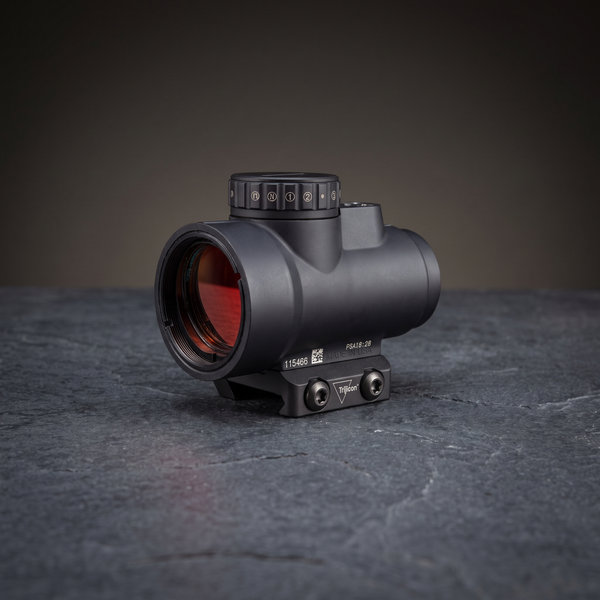
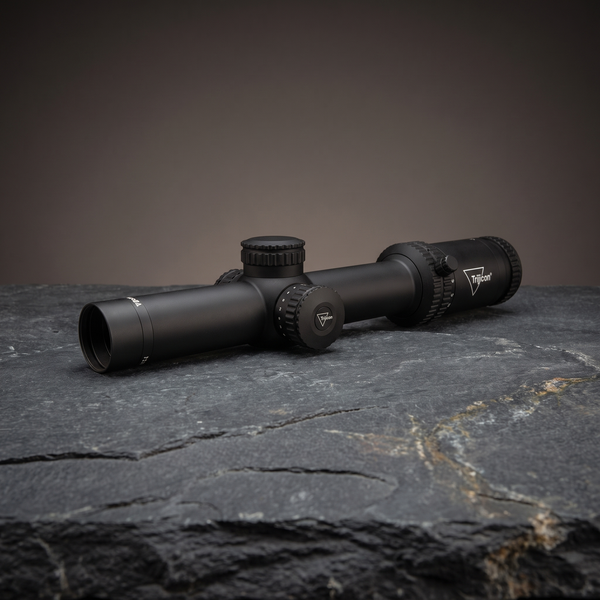
Shooters coming to stalking from carbines and clays ask this constantly: my red dot is fast, rugged and I shoot it well — can I take it deer stalking? Legally, in most of the UK, yes. Practically, it is the wrong tool more often than it is the right one, and the reason has nothing to do with the sight and everything to do with what you are legally required to be certain of before you press the trigger.
The legal answer: your sight is not regulated
Nothing in the Deer Act 1991 (England and Wales) prescribes a sight, a magnification or a reticle. Scotland regulated sights until recently — the Deer (Firearms etc.) (Scotland) Order 1985 restricted night sights — but that restriction was removed on 3 November 2023 by SSI 2023/332, as covered in our guide to night vision and thermal law. And as we explain in do you need a licence for a rifle scope, no optic of any kind goes on a certificate.
So the legal constraint is not the sight. It is the rifle, the bullet and — crucially — the standard of certainty the law and the welfare codes expect of you.
What the law does specify: calibre, bullet and energy
These are the minimum legal standards, and they differ by species and by country. The figures below for England and Wales come from Schedule 2 to the Deer Act 1991 as set out in the Deer Initiative's Rifles and Ammunition best practice guide and BASC's deer stalking code of practice. They are minima, not recommendations.
England and Wales
| Species | Minimum calibre | Minimum bullet weight | Minimum muzzle energy |
|---|---|---|---|
| Red, fallow, sika, roe | .240 in (6.1 mm) | None specified | 2,305 J (1,700 ft-lb) |
| Muntjac, Chinese water deer | .220 in (5.6 mm) | 3.24 g (50 grains) | 1,356 J (1,000 ft-lb) |
Scotland
Scotland works to bullet weight, velocity and energy rather than a single calibre threshold, and splits roe from everything else. BASC's code of practice gives the current figures as follows; the underlying instrument is the Deer (Firearms etc.) (Scotland) Order 1985, whose minimum bullet weight for non-roe species was reduced from 100 grains to 80 grains (6.48 g to 5.3 g) by SSI 2023/332 to make non-lead ammunition workable.
| Species | Minimum bullet weight | Minimum muzzle velocity | Minimum muzzle energy |
|---|---|---|---|
| Roe | 3.24 g (50 grains) | 747 m/s (2,450 ft/s) | 1,356 J (1,000 ft-lb) |
| Red, fallow, sika and other species | 5.3 g (80 grains) | 747 m/s (2,450 ft/s) | 2,373 J (1,750 ft-lb) |
Northern Ireland is different again, and sits under the Wildlife (Northern Ireland) Order 1985 rather than either of the above. If you stalk in Northern Ireland, take your figures from DAERA rather than from a GB source.
The bullet itself
Across the UK the bullet must be of a type designed to expand or deform on impact — hollow-nosed or soft-nosed in the statutory language, which is generally read as including bonded and polymer-tipped designs. Expanding ammunition for deer is held under specific authority on your firearm certificate, so check your conditions.
And the lead timetable
UK REACH restrictions on lead ammunition are now confirmed for England, Scotland and Wales. Per BASC's summary, lead bullets of 6.17 mm calibre and above are restricted for outdoor target shooting from 1 April 2028 (other than at ranges with approved risk management) and for live quarry shooting from 1 April 2029. Smaller calibres such as .22 rimfire are unaffected, as are airgun pellets. Northern Ireland is outside these regulations. If you are buying a rifle and glass now, it is worth building around ammunition you will still be using in 2029.
Why magnification usually wins for deer
Here is the part the legal minima do not tell you. Before the shot you have to establish, at distance and often in poor light, the species, the sex, whether the animal is in season, whether it is a lactating female with dependent young, its condition, the backstop, and then place a bullet in a vital zone roughly the size of a saucer. A 2 MOA dot covers about 50 mm (2 in) at 100 m and is a superb aiming point — but it does not help you see any of the things above.
That is the whole argument. A red dot is an aiming solution. Deer stalking is mostly an identification problem.
- Identification and censusing. Sex and age assessment on a roe buck at 120 m is genuinely hard at 4x, let alone 1x.
- Precision at realistic ranges. Most UK stalking shots fall between 50 and 150 m. At 150 m a 2 MOA dot subtends about 75 mm (3 in) — an appreciable share of the target you are trying to hit precisely.
- Low light. A stalking scope with a large objective and a big exit pupil gathers light in a way a reflex sight simply does not, and the legal shooting window is bounded by sunrise and sunset, not by daylight.
This is why our deer stalking scopes start low — 2.5x or 3x at the bottom end for woodland — rather than starting high.
Where a red dot genuinely earns its place
It is not never. There are real UK stalking jobs where a dot is the better answer:
- Muntjac and Chinese water deer in thick cover, where shots are inside 50 m, come fast, and the whole animal fills the field of view anyway.
- Driven and moving quarry abroad, and moving-target practice at home, where an unlimited-eye-relief 1x sight is unbeatable for tracking.
- As a second sight, not the only sight. A 45-degree offset red dot alongside a magnified scope gives you a genuine close-range option without giving up glass — an increasingly common setup on straight-pull rifles.
- Humane dispatch and follow-up at very short range.
If you go this route, dot size matters: bigger is faster and coarser, smaller is more precise. Our red dot size chart and what is MOA cover the trade-off, and you can browse red dot sights by dot size.
The sensible middle: LPVO and low-power prism
For a stalker who wants red-dot speed but refuses to give up identification, two formats solve it properly.
A low power variable optic at 1x with a daylight-bright centre dot behaves like a red dot in cover, then winds up to 6x, 8x or 10x when you need to look at an animal properly. See best LPVO rifle scopes and our LPVO range. A fixed prism scope at 3x or 5x gives you an etched reticle that works with a dead battery and is far kinder to astigmatism than a reflex dot — see prism scopes explained and our prism scopes.
Whichever you choose, mount it properly: rings and bases matter more than most people allow, and our mounts and rings buyer's guide and rifle scope mounts are the place to start.
This is not legal advice
The figures above are drawn from the statutory sources cited and from BASC and Deer Initiative guidance. Deer law is amended regularly, differs between England and Wales, Scotland and Northern Ireland, and interacts with conditions that vary by certificate and by force. Confirm the position for your species, your ground and your certificate with your firearms licensing department and with Natural England, NatureScot or DAERA before you act.
Frequently asked questions
Is it legal to shoot deer with a red dot sight in the UK?
No UK deer statute prescribes a sight type, so the legal constraints are the rifle, the calibre, the bullet and the muzzle energy. Whether it is appropriate is a welfare and certainty question, and for most stalking it is not.
What magnification do I need for deer stalking?
There is no legal minimum. In practice a variable starting at 2.5x or 3x and topping out around 10x to 15x covers almost all British stalking.
Can I use a .243 for red deer in England?
The statutory test in England and Wales is a minimum .240 in calibre and 2,305 J (1,700 ft-lb) muzzle energy with an expanding bullet. Check your specific load meets it, and note the lead restrictions arriving in 2029.
Is a red dot legal for muntjac?
The sight is not regulated. Muntjac and Chinese water deer have their own lower minima in England and Wales — .220 in, 3.24 g (50 grains) and 1,356 J (1,000 ft-lb).
Browse deer stalking scopes, rifle scopes and red dot sights, all held in our UK warehouse. If you want a second opinion on a setup for your ground, get in touch.