The .22 rimfire is how most British shooters arrive on a Section 1 certificate, and it is the rifle they keep shooting long after the centrefires arrive. Rabbits and rats around the buildings, club gallery rifle, a semi-serious benchrest habit — all of it happens between 25 and 100 m with a cartridge that costs pennies. That short working distance changes what a good scope looks like, and it is why a lot of rimfires end up wearing far more glass than the job needs. Everything named here is in our rimfire and .22 LR optics collection.
Parallax is the one spec that really matters
Parallax is the reason a scope built for a centrefire can be a poor fit on a rimfire. A scope's parallax setting is the distance at which the reticle and the target sit on the same optical plane; move your eye off the centre of the eyepiece at any other distance and the reticle appears to shift across the target. Most conventional hunting scopes are set at a fixed 100 yd, because that is where centrefire rifles are zeroed.
Shoot the same scope at 30 m at rabbits and the parallax error is real. It is not enormous — it will not turn a good shot into a miss on its own — but it introduces an inconsistency you cannot train out, and it gets worse the higher you wind the magnification.
There are three sensible answers to it, and we stock two of them.
- Fixed parallax set closer than 100 yd. The Burris Fullfield E1 3-9x40 in the Shotgun calibration is set at a fixed 50 yd — Burris chose that for slug ranges, and it happens to land exactly where rimfire work sits. The Muzzleloader version, 200347, is optically identical with the holdover points calibrated differently.
- Adjustable side focus that goes low enough. Useful, but check the bottom of the range before you buy. Several excellent scopes stop at 25 yd, which is fine, and plenty stop at 50, which is not much help at 20 m across a barn.
- Low magnification, which makes the whole problem small. At 2x to 4x, parallax error is a fraction of what it is at 12x. This is the quiet reason a modest scope shoots so well on a rimfire.
Why a big scope is the wrong answer here
A 5-25x50 on a 10/22 is a common sight and almost always a mistake. The reasons stack up.
- Weight destroys the handling. A .22 sporter weighs around 2.5 kg. Hanging 800 g of scope and rings on it changes the balance completely, and a rimfire is a rifle you carry and shoot offhand more than any other.
- Magnification you cannot use. At 25x, a 40 m rabbit fills the field and your own pulse becomes the dominant source of movement. The magnification does not help you hit it.
- Field of view collapses. Rimfire targets move. A wide field at low power is worth more than resolution you cannot hold still.
- Cost in the wrong place. Money spent on a big scope for a rimfire is money not spent on the ammunition that will actually improve your groups.
What we stock for a rimfire
| Optic | Magnification / objective | Tube | Reticle | Weight |
|---|---|---|---|---|
| Burris Scout 2.75x20 | 2.75x fixed, 20 mm | 1 in (25.4 mm) | Ballistic Plex, not illuminated | ~198 g (~7 oz) |
| Burris Scout 2-7x32 | 2-7x, 32 mm | 1 in (25.4 mm) | Ballistic Plex, not illuminated | 369 g (13 oz) |
| Burris Fullfield E1 3-9x40 | 3-9x, 40 mm | 1 in (25.4 mm) | Ballistic Plex, not illuminated | 369 g (13 oz) |
| SIG Sauer ROMEO5 Gen II | 1x red dot | — | 2 MOA dot | — |
| Primary Arms SLx MD-25 Gen II | 1x red dot | — | 2 MOA dot | — |
| Primary Arms SLx MD-21 | 1x red dot | — | ACSS-CQB | — |
The two Burris Scout scopes are worth explaining, because they are not conventional rimfire glass. They are long eye relief optics, with 234 to 305 mm (9.2 to 12 in) of eye relief, designed to sit forward of the action on a barrel-mounted rail. That layout keeps both eyes open with full peripheral awareness, which is why it suits fast close work — and on a rimfire with a forward rail it is a genuinely different shooting experience from a conventional scope. The fixed 2.75x20 is the lighter and simpler of the two at about 198 g; the 2-7x32 adds a top end and a larger objective at 369 g.
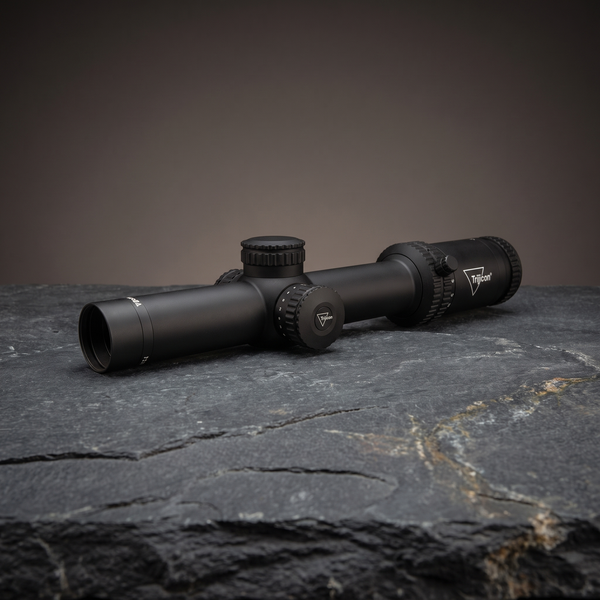
The Fullfield E1 3-9x40 is the conventional answer, and the more versatile one: 3-9x, 79 to 86 mm (3.1 to 3.4 in) of eye relief, 1/4 MOA clicks, 50 MOA of elevation and windage, no battery and nothing to switch on. Its fixed 50 yd parallax is the reason it sits in the rimfire collection at all.
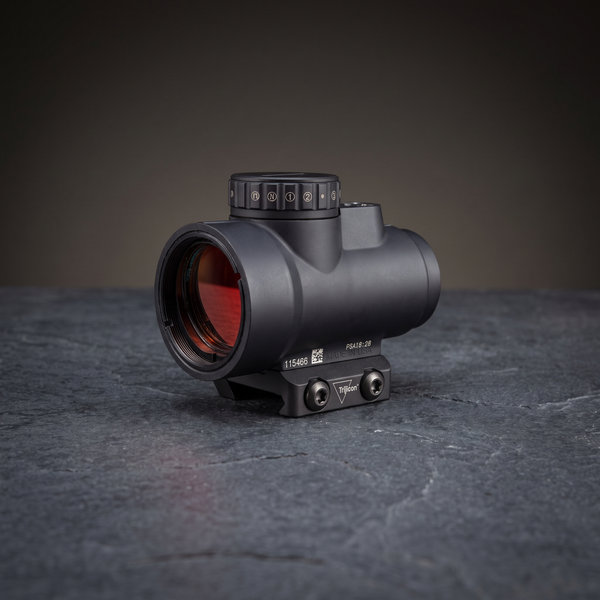
A red dot is also a completely legitimate choice on a rimfire used inside 50 m — for rats around buildings, for young shooters, and for anyone who finds a scope's eye box hard work. Our red dot size chart covers what dot size means at these distances, and red dot zero distance chart covers where to zero it.
Mounting: dovetail against Picatinny
This is where more rimfire orders go wrong than anywhere else, so it is worth being blunt about it.
Most .22 rimfire rifles — Ruger 10/22s, CZ 452 and 455 pattern, BRNO, Anschütz sporters and a long list of others — carry an 11 mm dovetail groove machined into the receiver, sometimes 3/8 in. That is not a Picatinny rail. It has a different width, a different profile and no recoil slots.
Every ring we stock — the Warne Maxima 1 inch low, medium and high quick-detach rings, and the lighter 6061-T6 HyperLite 1 inch low, medium and high rings — clamps to a Picatinny or Weaver rail. They are not dovetail rings. A rimfire with an 11 mm dovetail groove needs a Picatinny base fitted to it first, and we do not currently stock a dovetail-to-Picatinny adapter, so source that separately before ordering rings.
Two things follow. First, check what your receiver actually has before you buy anything. Second, if your rifle already carries a Picatinny rail — most modern tactical rimfires and every AR-pattern .22 do — then all of the above fits straight on.
For a Ruger 10/22 in a KRG Bravo chassis there is a dedicated answer: the Accu-Shot BT84 KRG 10/22 Bravo Rail Kit from B&T Industries adds a MIL-STD-1913 Picatinny rail to the chassis so a Precision Rail Monopod can be fitted, which is what turns a rimfire trainer into something you can shoot positionally with the same rear support as a centrefire.
Ring height follows the usual rule: the lowest ring that clears the objective bell. A 20 mm or 32 mm objective will sit in low rings; a 40 mm usually wants medium. Our mounts and rings buyer's guide covers it properly, and everything is in rifle scope rings.
Frequently asked questions
What magnification do I need on a .22LR?
2x to 9x covers virtually all rimfire shooting. Anything above about 12x is being carried rather than used, and it makes parallax error at close range worse rather than better.
Does a rimfire scope need adjustable parallax?
It helps, but it is not essential. A scope with fixed parallax set at 50 yd — like the Burris Fullfield E1 3-9x40 — is already a good match for rimfire distances, and low magnification shrinks the error further.
Will Picatinny rings fit my CZ or Anschütz?
Not directly. Those actions typically use an 11 mm dovetail groove, and Picatinny or Weaver rings will not clamp to it. You need a Picatinny base fitted to the receiver first.
Can I put a red dot on a .22 rimfire?
Yes, and inside 50 m it is often the faster option. You still need a Picatinny rail or a base to fit one to, and a dot for rimfire work generally wants to be small — 2 MOA rather than 6 — because rimfire targets are small.
Do I need a certificate for the scope itself?
Optics are dealt with separately from the rifle. We have set out where the line falls in do you need a licence for a rifle scope, red dot or torch, and the air rifle position — which is different again — is in what optics can you use on an air rifle.
Browse the rimfire and .22 LR optics collection, the wider rifle scopes range, red dot sights and Warne scope mounts. If the rimfire is a trainer for something bigger, our guide to the best scopes for deer stalking and to optics for a straight-pull AR cover where that leads. All UK-stocked and dispatched tracked, with no import charges to follow.