Deer stalking is the highest-value rifle discipline in Britain, and it is also the one where the optic does the most work. A stalking scope is not really an aiming device — it is an identification device that happens to have a reticle in it. You have to establish what the animal is, whether you should be shooting it, and what is behind it, usually in the first or last hour of light, before the reticle matters at all. That is the lens through which every recommendation below is made. Most of what follows is held in our deer stalking scopes collection; the Trijicon options at the end sit in the Trijicon rifle scopes range instead.
Magnification: woodland roe against open-hill red
Most British stalking is done a great deal closer than people expect. Woodland roe, muntjac and fallow in cover are routinely taken between 40 and 120 m, from a high seat or off sticks, often with the animal moving through trees. Open-hill red in Scotland is the opposite problem: 150 to 250 m, prone off a bipod, with wind and a long crawl behind you.
Those two jobs pull the magnification range in different directions, and the honest answer is that a scope which starts low is more useful than one that ends high.
- Woodland and high seat. You want 2.5x or 3x at the bottom. A wide field of view at low power is what lets you find a moving roe in cover at all, and 8x to 10x at the top is plenty for the ranges involved. The EOTech Vudu 3-9x32 with the illuminated HC1 MOA reticle is the archetype: 270 mm long, 556 g (19.6 oz), and nothing in the window you did not ask for.
- Mixed ground. A 2.5-12x or 3-15x does everything. The Burris Veracity 2.5-12x42 with the illuminated Fiber Dot Plex reticle covers woodland at 2.5x and a hill shot at 12x on the same stalk.
- Open hill and long shots. 4-20x with a dialling turret earns its place. The Burris Veracity PH 4-20x50 resolves elevation to 1/10 MOA through its PĒK programmable knob rather than in quarter-MOA clicks.
The stalking scopes we hold
| Scope | Magnification / objective | Focal plane | Reticle | Weight |
|---|---|---|---|---|
| EOTech Vudu 3-9x32 | 3-9x32 mm | SFP | HC1 MOA, illuminated | 556 g (19.6 oz) |
| EOTech Vudu 4-12x36 | 4-12x36 mm | FFP | MD5 MRAD, illuminated | 595 g (21.0 oz) |
| Burris Veracity 2.5-12x42 | 2.5-12x42 mm | SFP | Fiber Dot Plex, illuminated | 714 g (25.2 oz) |
| Burris Veracity 3-15x44 FFP | 3-15x44 mm | FFP | RC-MOA, illuminated | 703 g (24.8 oz) |
| Burris Veracity PH 4-20x50 | 4-20x50 mm | FFP | RC-MOA, illuminated | 825 g (29.1 oz) |
| SIG Sauer SIERRA6BDX 2-12x40 | 2-12x40 mm | SFP | BDX-R2 digital ballistic | 607 g (21.4 oz) |
| SIG Sauer BRAVO6T-BDX 3-18x44 | 3-18x44 mm | FFP | MRAD Milling 2.0, illuminated | 644 g (22.7 oz) |
| Burris Veracity 5-25x50 FFP | 5-25x50 mm | FFP | RCT-MOA, illuminated | 797 g (28.1 oz) |
The Trijicon stalking scopes
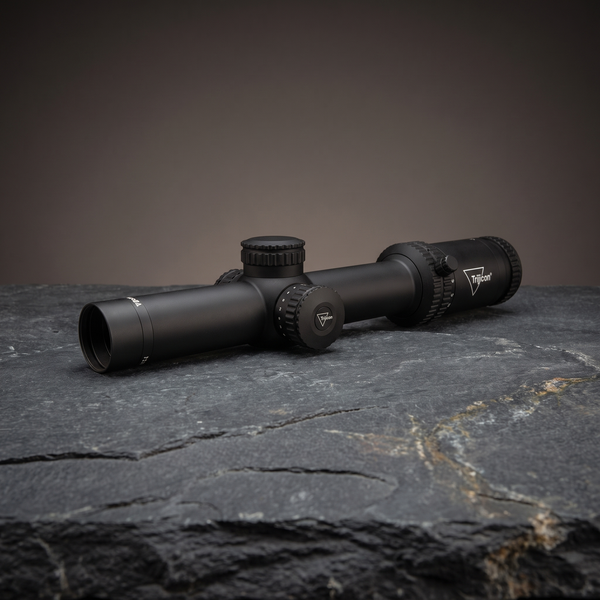
Trijicon's tube scope ranges came into stock after this guide was first written, and several of them are squarely stalking glass rather than tactical glass. They are worth knowing about because one of them does something nothing else here does.
- The battery-free option. The AccuPoint 2.5-10x56 lights its aiming point with a fibre-optic pipe in daylight and a tritium lamp after dark, with no cell anywhere in the scope. A 2.5x bottom end with a 56 mm objective is a serious low-light specification, and there is nothing to check before a stalk. The trade is that the brightness is not adjustable. The 2.5-12.5x42 is the lighter version of the same idea.
- The plain option. The Huron 3-9x40 with the German #4 reticle is a conventional non-illuminated second focal plane hunting scope, and the German #4 — three heavy posts and a fine upper wire — is a European woodland pattern designed precisely so the eye finds the centre against dark ground. Also in 2.5-10x40 and 3-12x40 with BDC Hunter Holds. No illumination at all is the honest caveat in the last twenty minutes of light.
- The adjustable-brightness option. The Credo HX 2.5-15x42 uses a battery LED with a plain centre dot, so you can wind the illumination down far enough that it does not bloom over the animal — the thing an AccuPoint cannot do.
- The entry point. The Ascent 3-12x40 is proper Trijicon glass without the illumination premium.
How the whole Trijicon line-up divides up — and which family does what — is set out in Trijicon rifle scopes decoded.
Low light is an exit pupil problem
The legal stalking window in Britain is bounded by sunrise and sunset, not by comfortable daylight, so a stalking scope spends a disproportionate share of its working life in poor light. The number that governs how bright the image looks is the exit pupil — objective diameter divided by magnification — and it should be at least as large as your own dilated pupil, which is somewhere around 5 to 7 mm depending on age.
Work it through on the scopes above and the argument makes itself. The Veracity 2.5-12x42 runs from 11.2 mm down to 3.7 mm; the 3-15x44 from 11 mm to 3.1 mm; the 5-25x50 from 9.8 mm to 2.7 mm. At the bottom of its range every one of them is generous. At the top, all three have dropped well below what your eye can use in the last twenty minutes of legal light. That is not a fault — it is arithmetic, and it applies to every scope ever made.
The practical conclusion is that in poor light you wind down, not up. Which in turn means a scope whose bottom end is 2.5x or 3x has more genuinely usable magnification range on a British evening than one that starts at 5x. It is also why a 56 mm objective at 2.5x, as on the AccuPoint above, is such a strong low-light specification.
Choosing a reticle
Reticle choice for stalking splits three ways, and all three are defensible.
- A plain illuminated centre. The Fiber Dot Plex on the Veracity gives you a classic Plex with an illuminated Fiber Dot centre, on 11 brightness settings with off positions between each so you can find the level you want without overshooting it. Nothing in the window competes with the animal.
- Holdover marks. The RC-MOA "Rapid Cross" reticle puts an 8-MOA illuminated centre cross with 1 MOA wind and elevation hashes in front of you, first focal plane, so the holds are true at any power. If you shoot beyond 200 m regularly this is the more useful reticle.
- A digital solution. The SIERRA6BDX pairs over Bluetooth with a SIG BDX rangefinder and simply lights a holdover dot at the correct elevation for the ranged distance. No dialling and no counting hashes. The 2-12x40 has fixed parallax at 100 yd; the 3-18x44 and 5-30x56 add adjustable parallax.
Whether you shoot MOA or MRAD matters less than being consistent between your turrets and your reticle — our what is MOA explainer and the MOA at distance chart cover the arithmetic, and FFP vs SFP explained covers the focal plane decision properly.
Why a 5-25x is usually too much glass
The 5-25x50 is a genuinely excellent scope. It is also, for most British stalking, the wrong one, and it is worth being specific about why rather than just asserting it.
- The bottom end is too high. At 5x you have a narrow field of view for a roe that breaks cover at 40 m. The 2.5-12x42 gives 12.8 m of field at 91 m at its lowest setting; the 5-25x50 cannot get near that.
- It is long and heavy. 387 mm and 797 g against 318 mm and 714 g for the 2.5-12x42, before rings. On a rifle you carry all day up a hill, that is felt.
- The travel is often lower. The 5-25x50 has 60 MOA of elevation and 26 MOA of windage; the 3-15x44 has 77 MOA of each. More magnification does not automatically mean more adjustment.
- You will not use the top half. Mirage, heartbeat and wobble at 25x on a field rifle make the image harder to shoot from, not easier.
Where a 5-25x or a 4-20x does belong is long-range practice, hill red at distance, and F-Class or benchrest work on the same rifle. If that describes your shooting, buy it deliberately rather than by default.
Mounting it properly
Every scope in the table above except the BRAVO6T-BDX is supplied without rings. The BRAVO6T-BDX ships with SIG's ALPHA5 1.250 mount and an LRF diving board in the box, so it is complete as bought.
For the rest, get the ring height right: the lowest ring that still clears the objective bell gives the firmest, most repeatable cheek weld. A 42 mm or 44 mm objective on a bolt gun usually wants medium rings; a 50 mm usually wants high. Every variable in the table takes 30 mm rings bar the 35 mm BRAVO6T-BDX, and the Warne Maxima 30mm medium quick-detach rings are the robust all-purpose option, with the Warne HyperLite 30mm medium rings the lighter 6061-T6 choice for a rifle that gets carried and the Burris XTR Signature 30mm rings a further alternative at 1.00 in height. Our mounts and rings buyer's guide covers the decision in full, and the whole range is in rifle scope rings and rifle scope mounts. If your rifle is a Tikka, Sako, CZ or Blaser, read the fitment guide for those actions first — most of them need a base before any ring will fit.
Supporting the rifle
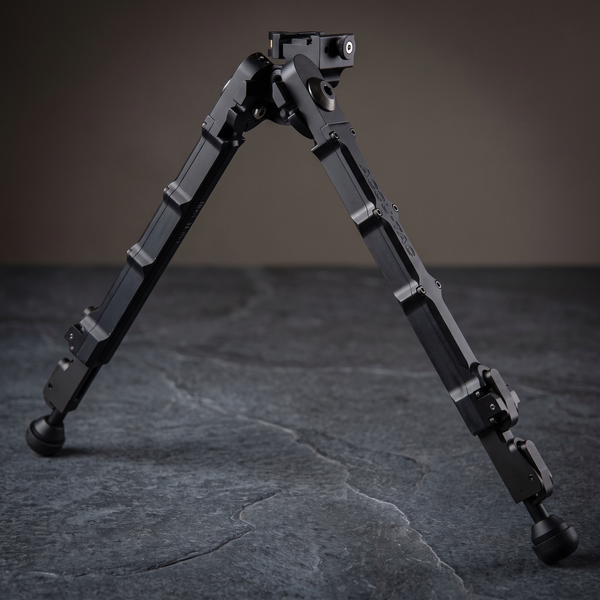
A stalking bipod is a different animal from a range bipod, because you are very often shooting seated from a high seat or kneeling in cover rather than prone. Height range and a head that cants to level on a slope matter more than they do on a firing point — we cover the choice in which bipod for which discipline, and the mounting interface, which is the commoner mistake, in which bipod fits your rifle. Most sporter stalking stocks present a plain sling stud and need an adapter before any bipod will attach.
Frequently asked questions
What magnification do I need for deer stalking in the UK?
For most British ground, a variable starting at 2.5x or 3x and topping out between 10x and 15x covers everything. The bottom end matters more than the top, because that is where you find the animal and where the exit pupil is largest in poor light.
Is a 3-9x40 still enough for deer?
Yes, for woodland and high-seat stalking it remains one of the most sensible specifications ever made. The EOTech Vudu 3-9x32 is the modern expression of it, and the Trijicon Huron 3-9x40 is the plain non-illuminated version.
Should a stalking scope be first or second focal plane?
Second focal plane keeps the reticle one clean size at every power, which suits a plain hunting reticle. First focal plane keeps holdovers true at any magnification, which matters if you hold rather than dial past 200 m.
Do I need an illuminated reticle for stalking?
It is the single most useful feature in the last half hour of light, when a black reticle disappears against dark ground. Every scope in the table above is illuminated except where noted, and the Trijicon AccuPoint achieves it without a battery.
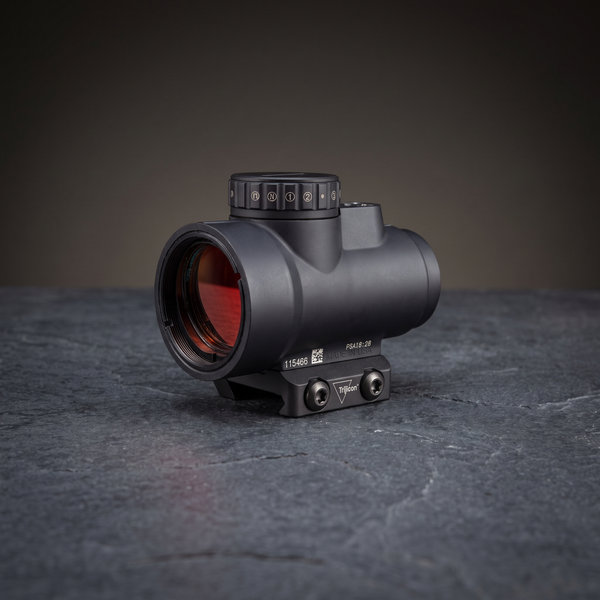
What about a red dot instead of a scope?
That is a longer answer, and we have written it up separately in can you use a red dot sight for deer stalking in the UK, along with what the law does and does not specify about sights.
Start with the deer stalking scopes collection, or browse the wider rifle scopes, Burris rifle scopes, EOTech Vudu range, SIG Sauer rifle scopes and Trijicon rifle scopes. If you also shoot foxes off the same rifle, our guide to optics for fox and night vermin control covers the night side of it, and do you need a licence for a rifle scope, red dot or torch answers the question we get asked most. UK-stocked, with £5 tracked UK delivery — the detail on duty and VAT is in buying optics in the UK.