The straight-pull AR is the AR-15 platform as Great Britain has it: the same ergonomics, the same handguard, the same rail, worked by a lever or a rotating handle instead of gas. It has become the default rifle for Civilian Service Rifle, practical rifle and a good deal of club gallery shooting, and it is used by people who came to it from every direction — from stalking, from clays, from nothing at all. Which is why "what optic goes on it" produces such wildly different answers. This is our attempt at a useful one, built entirely from stock, and everything named here sits in our straight-pull rifle optics collection.
Start with the course of fire, not the optic
The right answer depends almost entirely on what you actually shoot.
- Timed practical stages, close targets, movement. A 1x optic — red dot or 1x prism. Speed is the whole game and magnification is a liability.
- Service rifle style shoots out to 300 m and beyond, with deliberate fire. An LPVO, or a fixed prism at 3x to 5x. You need to see the target to score it.
- Both, on the same rifle, on the same day. An LPVO with a genuine 1x, or a magnified optic with an offset dot alongside it.
LPVO, prism or red dot
| Format | Magnification | Reticle | Works with a flat battery? | Typical weight |
|---|---|---|---|---|
| Red dot | 1x | Projected LED | No | Light |
| Prism | 1x to 5x fixed | Etched into the glass | Yes | Light to moderate |
| LPVO | 1-6x to 1-10x variable | Etched, usually illuminated | Yes, unilluminated | Moderate to heavy |
| ACOG | 3.5x or 4x fixed | Etched, fibre-optic and tritium lit | No battery to fail | Moderate |
The LPVO case
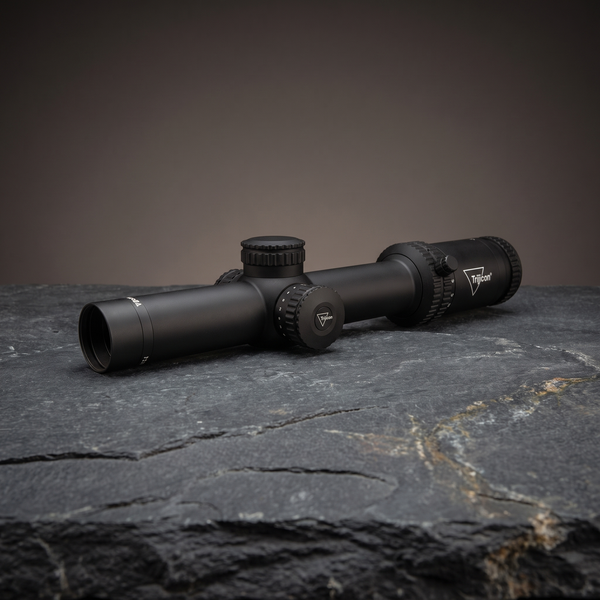
A low power variable optic behaves like a red dot at 1x with the illumination on, then winds up when you need to look at something properly. It is the most versatile single optic for this platform and the reason it dominates practical rifle.
The SIG Sauer TANGO-MSR 1-6x24 with the illuminated MSR BDC6 reticle is the straightforward version of this and the one we point most people at first, largely because of what is in the box: a 30 mm tube scope and a 34 mm-height ALPHA-MSR cantilever mount, ready to bolt to a Picatinny rail at the right height for an AR-pattern rifle. No rings to buy and no eye-relief guesswork. It is 267 mm (10.5 in) long and 525 g (18.5 oz). The 1-8x24 and 1-10x28 reach further, and the TANGO-MSR Compact 1-6x24 is shorter at 8.4 in if rail space is tight.
For a first focal plane reticle whose subtensions stay true at every power, look at the EOTech Vudu 1-6x24 FFP with the SR3 MOA 5.56 BDC reticle or the Vudu 1-10x28 FFP. For value with a well-thought-out reticle system, the Primary Arms SLx 1-6x24 Gen IV with the red illuminated ACSS Nova Fiber Wire reticle, or the PLxC 1-8x24 FFP with the ACSS Raptor 5.56/.308 Yard G2 reticle. The ACSS reticle explained covers what those reticles are actually doing, and best LPVO rifle scopes compares the magnification bands. Trijicon's own LPVOs — the Credo, the battery-free AccuPoint and the VCOG — are set out in Trijicon rifle scopes decoded.
The prism case
A prism scope is fixed magnification with the reticle etched into the glass, which buys two things a red dot cannot. It works with the battery flat, and it stays sharp for shooters with astigmatism, who commonly see a projected LED dot as a smear, flare or double image.
The Primary Arms SLx 3X MicroPrism with the ACSS Raptor 5.56/.308 Yard reticle is the sweet spot for this platform: fixed 3x in a body 75 mm (2.95 in) long and under 225 g (7.95 oz), 1/4 MOA clicks, 80 MOA of travel each way, 12.7 m of field of view at 100 m, and up to 29,000 hours from a CR2032 across 13 brightness settings — three of them night-vision compatible. It ships with a ruggedised mount offering eight height options, so the mounting problem is solved in the box.
At 1x, the SLx 1X MicroPrismT with the ACSS Cyclops Gen II reticle is 63 mm (2.48 in) and 156 g (5.5 oz) on the H1/T1 micro-dot footprint with a 2.26 in mount included — a prism that is genuinely micro-dot sized. The Holosun MP3X 3x24 is the alternative at 3x with red and green illumination. See prism scopes explained.
The red dot case
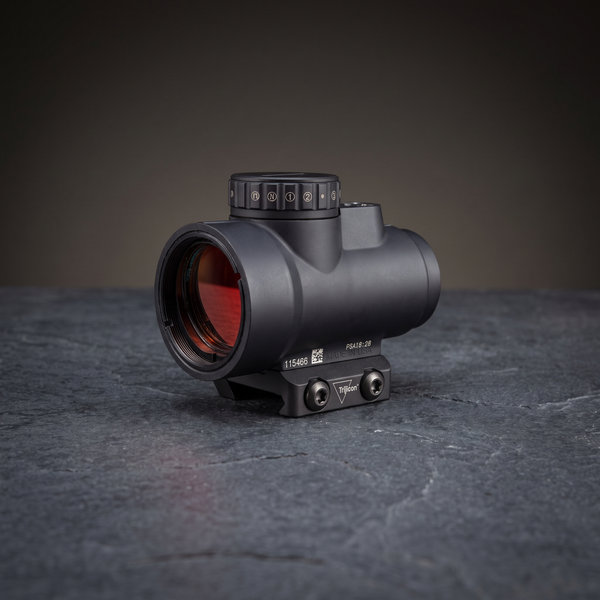
For stages measured in seconds a 1x dot is still the fastest thing there is. The Trijicon MRO SD Patrol gives a plain 2.0 MOA dot on Trijicon's tool-free Q-LOC quick-release mount, and the MRO HD Patrol adds a switchable 68 MOA circle around the dot. The MRO is sold as a separate product for every mount height, so read which Trijicon MRO before ordering one. The Holosun HS510C brings the Multi-Reticle System and an integrated QD Picatinny mount at 35.8 mm (1.41 in) dot height.
If you want to keep the dot's speed but add reach, a flip-to-side magnifier is the usual answer — the Holosun HM3X 3x, the EOTech G43 3x with the STS mount or the SIG JULIET3 3x. Our choosing a red dot magnifier guide covers 3x against 5x and 6x.
And the ACOG
Trijicon's ACOG deserves its own line because it does something none of the above does: the reticle is lit by fibre optic in daylight and tritium at night, with no battery anywhere in the system. The ACOG 4x32 with the Crosshair .223 BAC reticle and the 3.5x35 models are all in the Trijicon ACOG range. Fixed magnification and a short eye box are the trade, and it is a real trade — but nothing else on this list is immune to a dead cell. Choosing between the magnifications, reticles and illumination types is a guide in itself: see the Trijicon ACOG buyer's guide.
Mount height, and why it is not a detail
Mount height is the thing people get wrong most often on this platform, and unlike most mistakes it cannot be fixed by shooting more.
An AR-pattern rifle has a comb line that sits high relative to the bore, so an optic mounted at a bolt-gun height puts your cheek nowhere useful. The standard heights exist for that reason:
- Absolute co-witness, around 35.8 mm (1.41 in). Iron sights sit in the middle of the window. The Holosun HS510C's integrated mount is at this height.
- Lower 1/3 co-witness. Irons sit in the bottom third, giving a cleaner view. Trijicon offers the MRO HD Patrol on a lower 1/3 co-witness Q-LOC mount.
- Raised heights, 1.93 in and 2.26 in. A more upright head position, easier in armour or a heavy coat, and increasingly common on modern builds. The SLx 1X MicroPrismT ships with a 2.26 in mount.
Our red dot mount height chart and co-witness heights explained set out the whole picture. For a tube scope, what you need is a cantilever mount — the rings sit forward of the clamp so the scope can be set far enough back on a straight-pull action to give proper eye relief. The American Defense AD-RECON 30mm standard height is the archetype, machined from 6061-T6 with a Type III hardcoat and using ADM's Auto Lock lever, which self-adjusts to in-spec and out-of-spec Picatinny rails and returns to zero when refitted. It is also made in medium and high, in 1 inch, and as the AD-RECON-X extended cantilever. Full range in rifle scope mounts and our mounts and rings buyer's guide.
Frequently asked questions
Is an LPVO or a red dot better on a straight-pull AR?
An LPVO if you shoot at varied distances or need to identify targets; a red dot if your shooting is close, fast and timed. An LPVO at 1x with illumination on gets close to red dot speed, at the cost of weight and a fixed eye box.
What magnification LPVO should I buy?
1-6x is the classic and the lightest. 1-8x has become the sweet spot for reach against weight. 1-10x buys the most distance and pays for it in length and a smaller exit pupil at the top.
Why would I choose a prism over a red dot?
Astigmatism, and battery independence. A prism's reticle is etched into the glass and resolved through the optic's own focusing system, so it stays sharp where an LED dot smears, and it still works with the cell flat.
What mount height do I need on an AR-pattern rifle?
Absolute co-witness at about 35.8 mm (1.41 in) or lower 1/3 are the traditional choices; 1.93 in and 2.26 in raised mounts are increasingly common. Pick the one that puts your cheek naturally on the stock without lifting your head.
Do I need a cantilever mount?
For a tube scope on an AR-pattern rifle, almost always. The forward ring position is what lets you set the scope back far enough for correct eye relief on a receiver-length rail.
Can I run an offset dot alongside a scope?
Yes, and it is a common arrangement on this platform — a 45-degree offset red dot gives a close-range option without giving up the magnified optic.
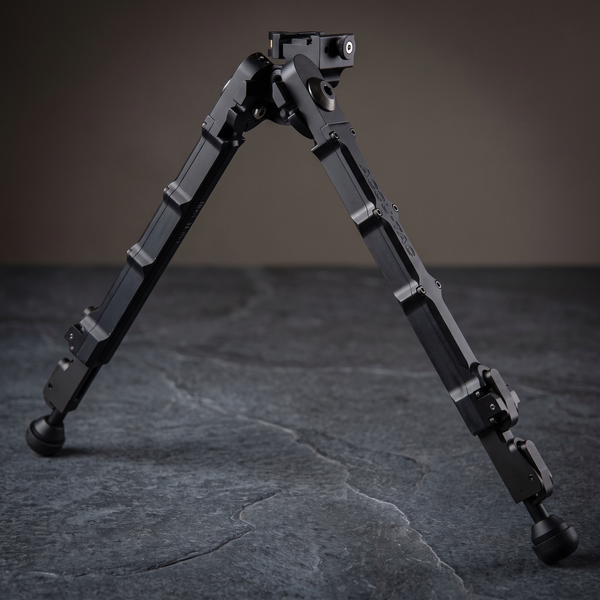
Browse the straight-pull rifle optics collection, plus LPVO rifle scopes, prism scopes, rifle dot sights, red dot sight magnifiers and AR-15 optics. If the same rifle does other jobs, our guides to scopes for deer stalking, optics for fox and night vermin control and optics for practical shotgun cover the rest of the cluster, and do you need a licence for a rifle scope, red dot or torch answers the licensing question. Shooting it off a bipod? See which bipod fits your rifle. Duty paid, with £5 tracked UK delivery.