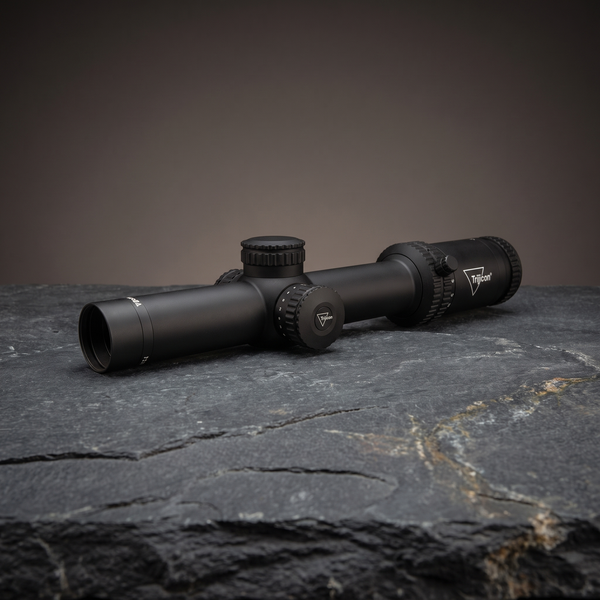
The ACOG is the optic people recognise on sight and then struggle to buy, because the range is far larger than its reputation suggests. There is not one ACOG. There are six magnifications, three completely different ways of lighting the reticle, six reticle patterns and bullet drop curves cut for three separate cartridges — and the model code on the box, something like TA31F or TA110-C-100491, tells you all of it if you know how to read it. This guide takes the range apart in the order the decisions actually come at you.
First, what an ACOG actually is
ACOG stands for Advanced Combat Optical Gunsight, and underneath the military history it is a fixed-power prism scope. The reticle is etched into the prism glass rather than projected onto it by an LED, which is the single most important fact about the whole family: the aiming point is physically there in the glass. Illumination makes it brighter and easier to pick up, but with the illumination doing nothing at all you still have a complete black reticle with all of its bullet drop marks. Nothing can go flat and leave you with an empty tube.
That etched reticle is also why the ACOG suits shooters with astigmatism, who commonly see a projected LED dot as a smear or a starburst. We cover why in astigmatism and red dot sights, and the general case for the format in prism scopes explained.
Decision one: how the reticle is lit
This is the choice people miss entirely, and it changes what the optic is. Three systems are in the range and they are not variations of the same thing.
| System | How it works | Battery? | Brightness adjustable? |
|---|---|---|---|
| Dual-illuminated (BAC) | A fibre-optic light pipe along the top of the housing gathers ambient daylight; a sealed tritium lamp lights the same reticle after dark | None | No — self-regulating to ambient light |
| LED | A battery-powered LED illuminates the same etched reticle | Yes | Yes, by setting |
| Tritium only | Tritium lamp with no fibre-optic pipe | None | No |
The dual-illuminated models are the classic ACOG and the reason for the legend. The 4x32 Chevron .223 BAC (TA31F) has no battery anywhere in it and never will. The trade is that you cannot turn the brightness down. In flat British overcast the fibre gives you a sensible reticle; step from a dark wood into bright snow or sunlit stubble and it will be brighter than you want, and there is no dial.
That is precisely what the LED models exist to solve. The 4x32 LED Crosshair (TA02) and the 3.5x35 LED Chevron (TA110-C-100491) keep the etched reticle and add an adjustable LED on top of it. You gain control and give up the never-needs-anything simplicity.
One honest point about tritium that nobody makes. Tritium is radioactive and decays, with a half-life of about 12.3 years. A dual-illuminated ACOG's night-time brightness therefore falls steadily across the life of the optic, and Trijicon warrant the lamp for a stated term from date of manufacture rather than for life. The optical system and metal structure carry their Limited Lifetime Warranty; the lamp does not. On a twenty-year-old ACOG the daylight fibre still works perfectly and the tritium will be noticeably dimmer than it was.
Decision two: magnification
Fixed power is the ACOG's defining constraint. There is no dial — you choose the magnification once, at purchase, and live with it.
| Model | Magnification / objective | What it is for |
|---|---|---|
| TA44 1.5x16S | 1.5x / 16 mm | Close-quarters speed, near red-dot handling |
| TA47 2x20 | 2x / 20 mm | Compact carbine, a touch of magnification for target ID |
| TA11 3.5x35 | 3.5x / 35 mm | The generalist — bigger objective, longer eye relief than the 4x32 |
| TA31 4x32 | 4x / 32 mm | The archetype, and the one most people mean by "ACOG" |
| TA55 5.5x50 | 5.5x / 50 mm | Longer deliberate shooting, much larger body |
| TA648 6x48 | 6x / 48 mm | The long-range end, usually in .308 |
For a straight-pull AR shot at Civilian Service Rifle and practical distances, 3.5x or 4x is the answer nearly every time. The 1.5x and 2x models are close-quarters tools that give up too much target identification at 200 m and beyond, and the 5.5x and 6x are large, heavy and slow to pick up close in. Our guide to optics for a straight-pull AR sets the ACOG against LPVOs and red dots for that rifle.
The 3.5x35 versus 4x32 question
These two sell in similar numbers and the choice is not really about the half-times magnification. The 4x32 has 1.5 in (38 mm) of eye relief, which is short, and a correspondingly tight eye box — your head has to go in the same place every time or you get shadowing round the edge of the image. The 3.5x35 gives more eye relief and a 35 mm objective for a brighter picture. If you are new to prism optics, or your rifle's stock does not let you get your eye consistently close, take the 3.5x35. Trijicon also cut the 3.5x35 body for .308/7.62 (TA11E), which the 4x32 is not.
Decision three: the reticle, and the calibre it is cut for
Every ACOG reticle carries bullet drop compensating marks below the aiming point, and those marks are cut for one specific cartridge and bullet weight. A .223 55gr BDC used on a .308 rifle will not hold where it says. Check the calibre before the pattern.
- Chevron. A pointed chevron whose tip is the aiming point. The finest, least obscuring option and the one to choose for precision — the tip covers almost nothing. Also doubles as a ranging reference. Available in .223 red, .223 green and .308.
- Crosshair. Conventional intersecting lines. Familiar to anyone coming from a hunting scope and the easiest to get on with — see the 4x32 Crosshair .223.
- Horseshoe/Dot. A horseshoe around a centre dot. Fastest of the magnified patterns for both-eyes-open work, because the brain centres a large shape quickly — the 4x32 Horseshoe/Dot.
- RTR (Rapid Target Reticle). A large illuminated ring with a centre point and drop marks under it, built for speed. Found on the low-magnification bodies such as the 1.5x16S, including a version cut for 9mm pistol-calibre carbines.
- Triangle and Ring & Dot. Simplified patterns without BDC stadia — a plain MOA triangle or a ring with a 2 MOA dot. Choose these when you intend to zero for one distance and hold centre.
Red or green is largely personal, with the same caveat as any illuminated optic: some shooters resolve green more crisply, and it is worth looking through both if you can. Our green versus red guide covers the general case.
Mounting: check what is in the box, because it changed
This catches people out on the current range. Older ACOG models carry an integrated mount — the TA31F and its siblings have the base built into the body, so what you fit to the rail is the optic itself. Much of the newer range ships instead with a removable Trijicon Q-LOC quick-release Picatinny mount, which is a separate component that throws a lever and comes off the rifle without tools. The 1.5x16S is one of those: 145 g (5.1 oz) as an optic, about 204 g (7.2 oz) once the Q-LOC mount is on it.
Either way an ACOG needs a Picatinny rail, and it needs to sit far enough back that your eye reaches the short eye relief. On an AR-pattern or straight-pull receiver rail this is normally straightforward. On a bolt gun with no rail, read our fitment guide to Tikka, Sako, CZ, Blaser and Weaver actions first, because most of those rifles need a base fitted before any ACOG will go on.
Trijicon's Q-LOC mounts and rings range also covers conventional tube scopes in 30 mm, 34 mm and 35 mm at low, medium, high and extra-high, plus cantilever mounts with and without 20 MOA of built-in cant. Those are for tube scopes rather than for ACOGs — an ACOG does not use rings.
Adding a red dot on top
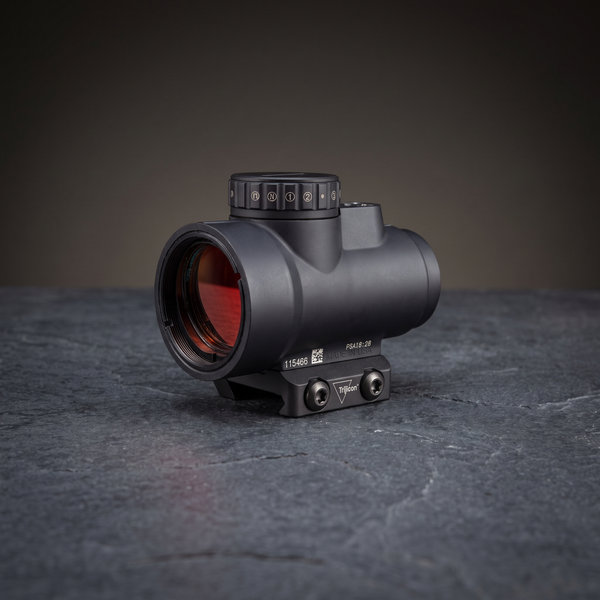
Fixed magnification is limiting at very close range, and the standard answer is a small red dot piggybacked above the ACOG. On models with mounting bosses on the top of the housing, the Trijicon RM35 (AC32007) and RM66 (AC32029) carry an RMR or SRO there. Check your ACOG actually has bosses before buying a mount for them.
Trijicon also sell it done for you: the 4x32 Chevron with RMR fitted (TA31-D-100549) and the 4x32 with the RCR arrive as a complete two-optic package. The alternative arrangement is a 45-degree offset red dot beside the ACOG rather than above it, which many practical shooters prefer.
Who should not buy an ACOG
Worth saying plainly. If you shoot at varied distances and want to identify quarry properly, a variable optic will serve you better — an LPVO winds from 1x to 8x or 10x and an ACOG cannot. If you are stalking, a 4x fixed with 38 mm of eye relief and a 5.56 BDC is the wrong tool; look at deer stalking scopes instead. And if the appeal is purely the look, understand that you are paying a four-figure sum for a fixed-magnification optic with a tight eye box.
Where the ACOG is genuinely unbeaten is the specific combination of a magnified, calibre-calibrated etched reticle that works with nothing switched on, in a body that has survived decades of military use. For a straight-pull service rifle shot at known distances, that is exactly the right set of trade-offs.
Frequently asked questions
Does a Trijicon ACOG need batteries?
The dual-illuminated and tritium models do not — a fibre-optic pipe lights the reticle in daylight and a tritium lamp lights it after dark. The LED models in the range do take a battery, in exchange for adjustable brightness. All of them have an etched reticle that remains usable with no illumination at all.
What is the Bindon Aiming Concept?
Trijicon's term for shooting an illuminated ACOG with both eyes open. The reticle is bright enough that the brain takes the aiming point from the magnified sighting eye while still using the unmagnified view from the other, so you keep situational awareness at magnification.
Which ACOG magnification should I choose?
For a straight-pull AR at service and practical distances, 3.5x or 4x. Take the 3.5x35 if you want more eye relief and a brighter picture, or if you shoot .308 — Trijicon calibrate that body for 7.62 and do not calibrate the 4x32 for it.
Is the ACOG reticle calibrated for my calibre?
Only if it says so. Every BDC in the range is cut for a specific cartridge and bullet weight — .223/5.56 55gr, .308/7.62 or 9mm for pistol-calibre carbines. The stadia will not hold on a different load.
Does an ACOG come with a mount?
Yes, but check which kind. Older models have the mount integrated into the body; much of the newer range ships with a removable Q-LOC quick-release Picatinny mount instead. Both need a Picatinny rail on the rifle.
Does the tritium wear out?
It decays. Tritium's half-life is about 12.3 years, so night-time brightness falls gradually over the optic's life, and Trijicon warrant the lamp for a stated term from manufacture rather than for life. Daylight fibre-optic illumination is unaffected.
Browse the full Trijicon ACOG range, or the wider Trijicon rifle scopes and Trijicon optics collections. For the rest of the platform see straight-pull rifle optics, prism scopes, Trijicon RMR sights and all rifle scopes. Related reading: our Trijicon buyer's guide, what is MOA for reading the stadia, and which bipod fits your rifle if the same rifle needs support. Optics need no licence in the UK — see do you need a licence for a rifle scope, red dot or torch. Duty paid, with £5 tracked UK delivery.